


Application / SDK / gateway
- Each application needs an SDK, callback, or gateway integration
- Closed-source CLIs are limited to the logs they expose
- Traces often stop at framework or process boundaries
- Subprocess and local file activity can be missed
Agent System Layer
Long-running AI agents cross models, tools, processes, files, and networks. AgentSight observes and explains that execution, ActPlane turns policy into enforcement at operating-system boundaries, and Akeep preserves provider-native session history so days or weeks of work remain inspectable and recoverable.
01
Inspect active sessions, processes, model and tool calls, file and network activity, and resource use.
02
Connect prompts, skills, and tool decisions to system effects, attention shifts, iteration paths, and failures.
03
Compile intent and temporal context into allow, block, kill, or notify decisions at operating-system boundaries.
04
Version provider-native session files, verify history integrity, and continue after a device or provider changes.
Application-level tools explain prompts, tokens, evals, and latency. The system layer continues the story: what actually executed, whether policy held on the execution path, and whether interrupted work can be recovered from trustworthy history.
Application / SDK / gateway
Agent system layer
Start from real problems in long-running work, platform integration, and governance.
Days or weeks of autonomous work
See where attention moved, which files and modules changed, how tests and implementation alternated, and where attempts repeatedly failed.
Platform / SRE
Export system behavior from closed-source CLIs and mixed agent frameworks into existing tracing or profiling pipelines without modifying each agent.
Security / governance
Use AgentSight for execution evidence, ActPlane for enforced policy, and Akeep for verifiable, recoverable session history.
These are existing project interfaces and presentation visuals: AgentSight makes long-running execution observable, ActPlane moves policy onto the execution path, and Akeep preserves native history for inspection and recovery.
Move from agents running now, to attention moving across a week, to where time and tool calls accumulated.
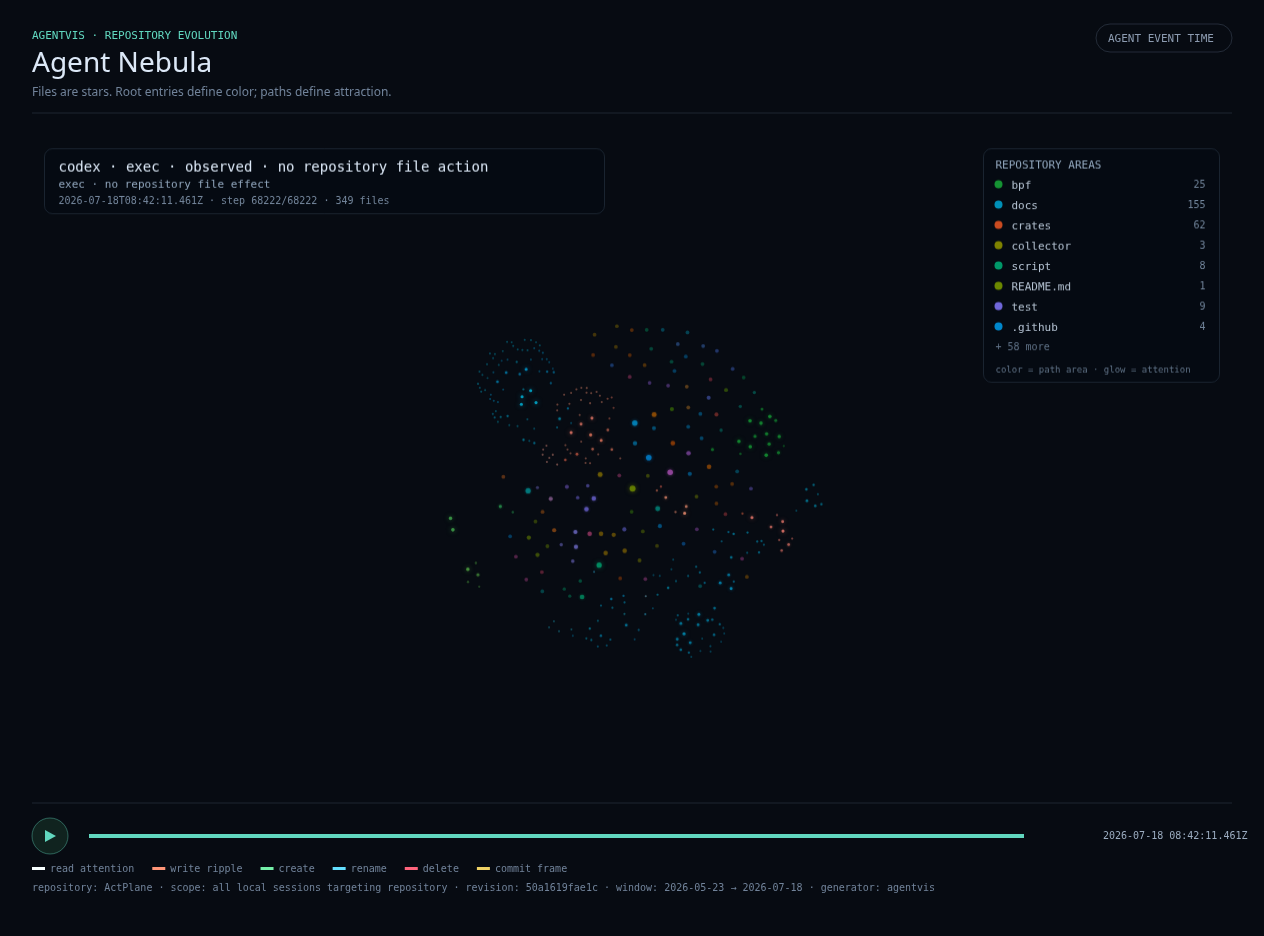
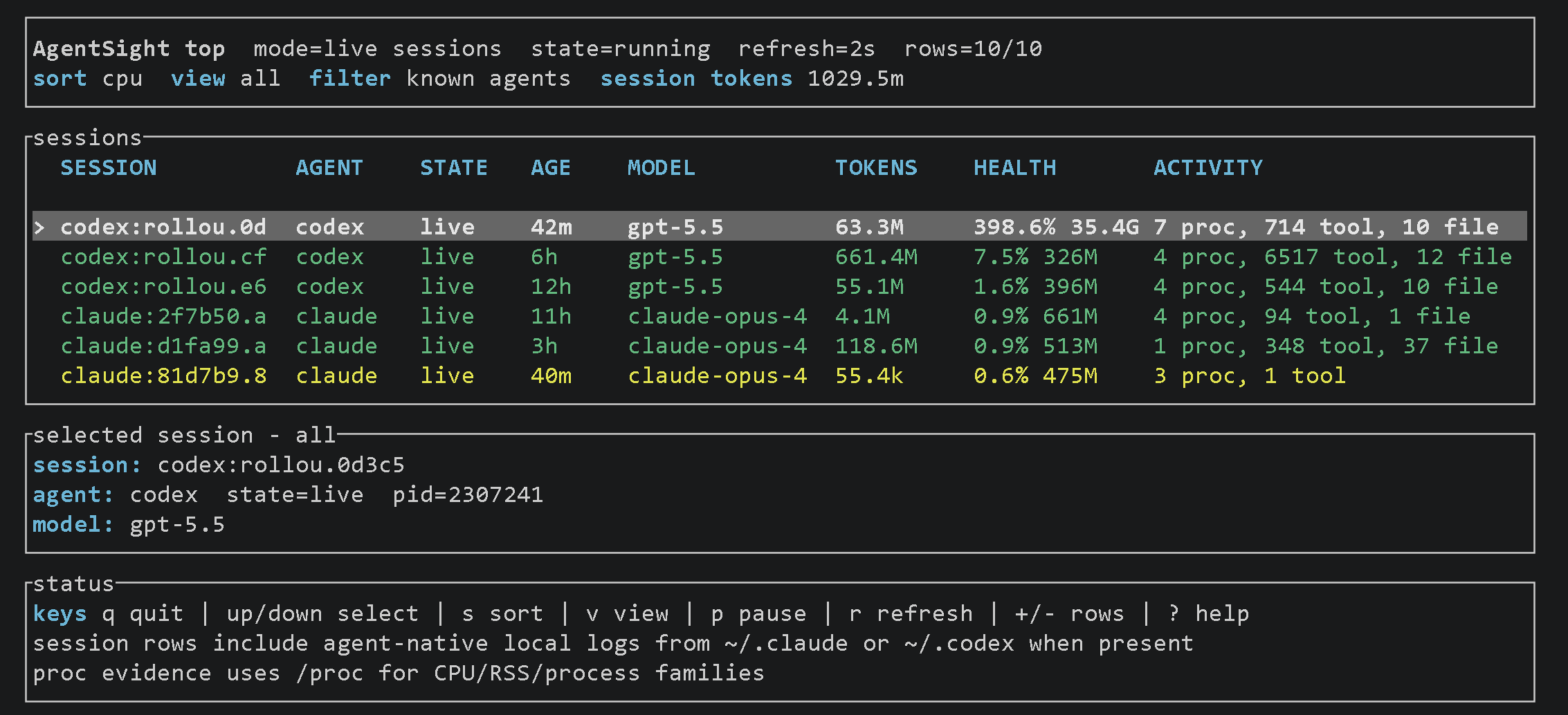
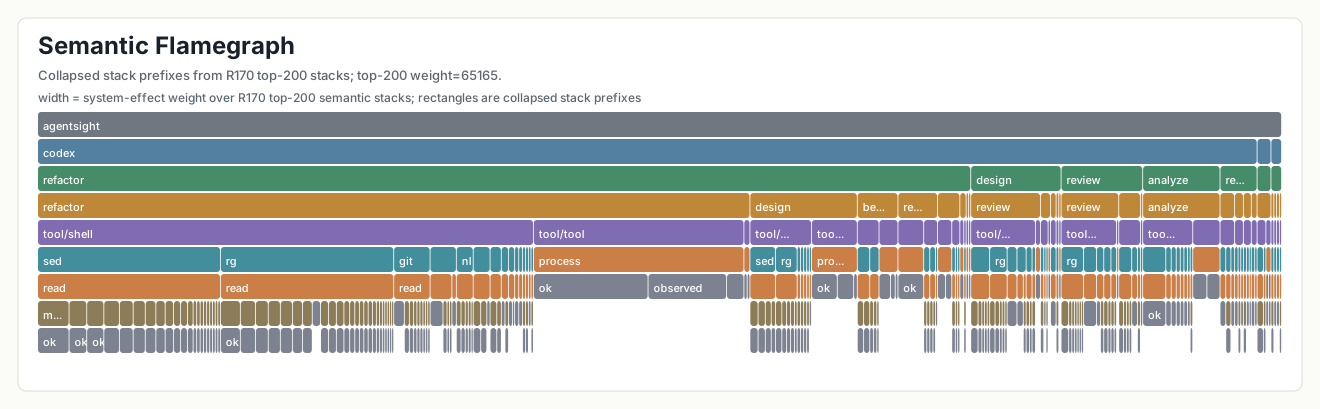
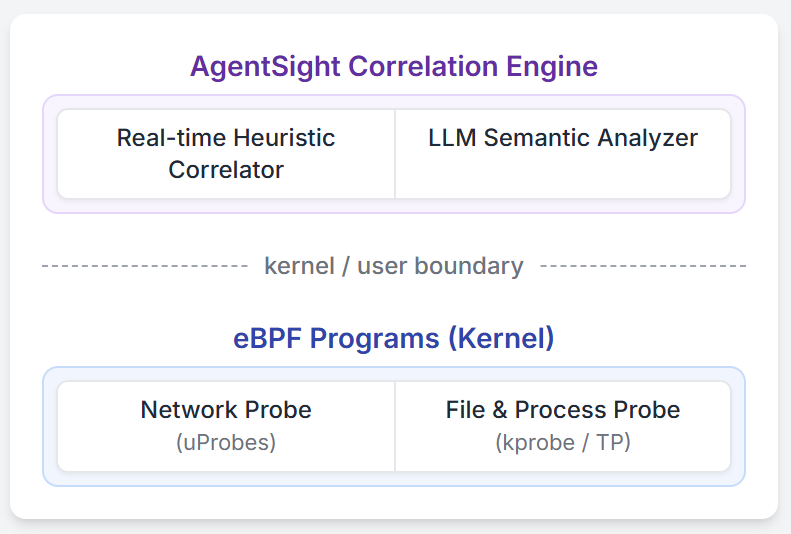
High-level rules compile into system policy; interpretation stays in userspace while enforcement sits on kernel paths every process must cross.
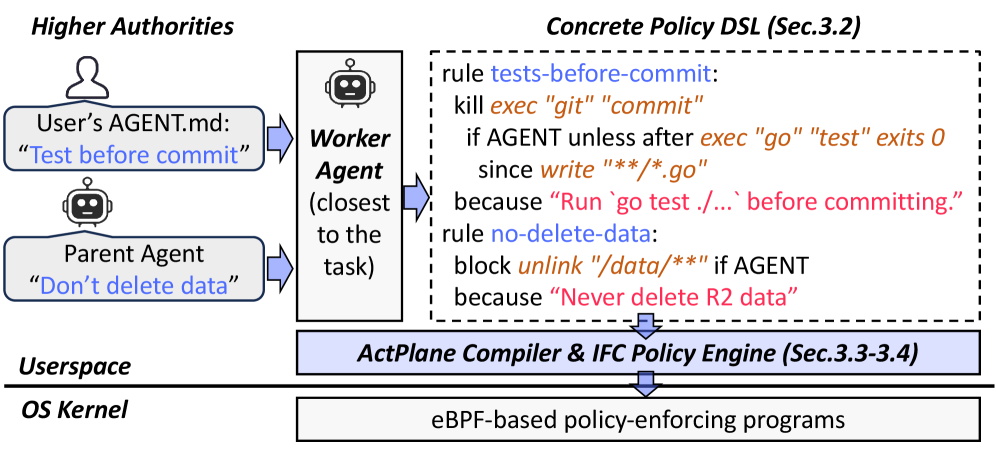
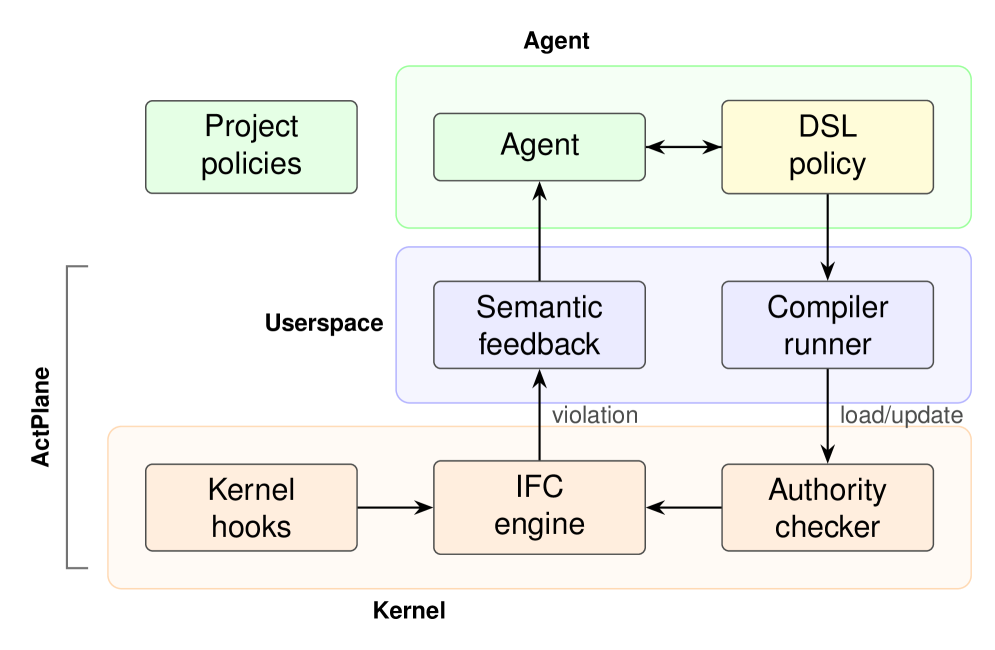
Akeep versions provider-native files directly. Ordinary use can be a commit; diff, integrity checks, and recovery are available when needed.
Day 1 akeep commit -m "first working path"
Day 2 akeep commit -m "after failed migration"
Day 7 akeep diff HEAD~1 HEAD
When a device or provider changes, the history remains inspectable, verifiable, and recoverable.
akeep fsck HEAD
akeep checkout HEAD --to /tmp/recovery
Continue.
Observe & explain
Local-first AI agent profiling and monitoring that connects prompts, models, and tool decisions to process, file, network, and resource activity, with reports, agentpprof, and OpenTelemetry export.
Enforce
Compiles intent and temporal context into policy enforced across syscall, exec, file, and network paths, with concrete feedback when an action is denied.
Preserve & recover
Versions provider-native agent session files for integrity checks, diffs, and recovery without converting history into another agent-memory format.
Contact
Operated and maintained by Eunomia Labs, Inc., with a focus on systems engineering for eBPF, runtime extension, and AI agent infrastructure. Reach out directly for enterprise evaluation, POCs, and production integration.